Showing posts with label American Civil War. Show all posts

Thursday, July 7, 2011

RIP - Colonel Strong Vincent

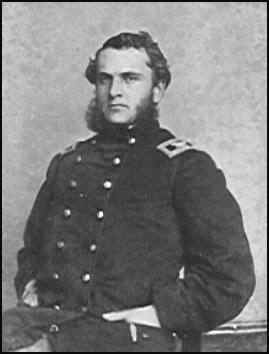
In Memoriam:  Colonel Strong Vincent, of the V Corps, who with quick wits and even quicker thinking, saved Little Round Top, and with it the entire left flank of the Union Army, for the Federals.  For this action, he was rewarded with a mortal wound and a deathbed promotion to Brigadier General.  Three cheers for Colonel Strong Vincent: the Savior of Gettysburg!

Hip Hip Huzzah!

Hip Hip Huzzah!

Hip Hip Huzzah!

RIP - Colonel Strong Vincent
       -Wounded 02 July 1863, Gettysburg
       -Died 07 July 1863

The Union owes you a debt that can never be repaid.  Rest in peace, for your sacrifice was not in vain, the Union was saved.

Sunday, July 3, 2011

Gettysburg - The Third Day

As night fell over the Gettysburg Battlefield, the fighting mostly died down.  Only the cries of the wounded still punctuated the stillness of the night.  On both sides, councils of war took place, Meade and Lee were both determined to stand and fight, but the direction that this battle would take was squarely in Lee's hands.  While Longstreet still counseled a shift in the army's position in order to fight a more defensive battle on ground more favorable to the Confederates, Lee was firm in his commitment to the present positioning.  Lee's initial plan was to renew the attacks on both Federal flanks in the morning, but an early morning Union artillery barrage would result in an early failure of the attacks on Culp's Hill, necessitating a change.  Instead of flank maneuvers, Lee proposed that Longstreet would instead attack the center of the Union line on Cemetery Ridge, where it was believed that the line was the weakest (due to heavy reinforcements shifted to Culp's Hill and the Round Tops).  Once Longstreet's men had broken through, effectively separating the Union Army in half, the Confederates would be able to defeat each half separately.  To accomplish this task, Lee gave Longstreet two divisions from A. P. Hill's Corps, those commanded by Brig. General Pettigrew and Maj. General Trimble, to fight alongside Maj. General George Pickett's division.  As seen on the map, the target of this assault was the Union II Corps, commanded by Maj. General Hancock.  In retrospect, it is often wondered how anyone could have thought that such a charge could have possibly succeeded.  In fact, the ultimate futility of this attack was accurately predicted by Lt. General Longstreet and his criticism of it (and of the commander who ordered it, Lee) would serve to make him persona non grata after the war.

In the Union Council of War, General Meade and officers debated the proposed actions of the Confederates the next day.  Meade for his part correctly predicted that Lee would attempt an assault on the center of the Union line, in particular the area commanded by II Corps' Brig. General John Gibbon.  In fact, with this prediction Meade would have made an excellent fortune teller, the famed Oracle at Delphi could have made a more accurate prognostication, since Gibbon's sector did indeed endure the Confederate attack.  The Union position, with its fortified cover, well-placed artilery and superior high ground posession, was well suited to defend itself against any Confederate assault.

03 July 1883 --- The Great Confederate Assault did not begin auspiciously for the Rebels.  Though Picket's Division had not yet seen action at Gettysburg, all of A. P. Hill's divisions had.  With General Hill in ill health, he did not have a say in which troops were chosen to participate.  This led to some of his corps who had done heavy fighting on 01 July being picked to make the charge over those who had fought only lightly on 01 July and not at all on 02 July.  In addition, the assault on Culp's Hill and a cavlary action in the Union rear by Maj General J. E. B. Stuart (who's absence of the previous days had caused Lee to act blindly) accomplished little and failed to force Meade to divert troops to those areas, further weaking the Union center.  Supporting actions on General Pickett's right by Wilcox and Lang, were late in starting and ended-up occurring after the charge was already in retreat.  However, before the charge could begin Lee planned on using his artilery to soften up the Union center.  This bombardment was the largest of the war and probably one of the loudest manmade sounds every heard, with hundreds of cannons on both sides firing for almost two hours.

Starting at 1:00 p.m., between 150 and 170 Confederate cannons opened up on the Union center.  This barrage caused damage all along the Union line, a shell even exploded near Meade's headquarters, killing an orderly and forcing the general to evacuate his staff and hurting infantry morale.  The Federal artillery chief, Brig. General Henry Hunt, had only about 80 cannons with which to respond (the geographic features of the Union position had limited areas for effective gun placement) but he was soon responding vigorously.  However, despite the numerical superiority of Confederate artilery, they barrage did not have the desired effect.  Most of the shells fired landed well back of the Union lines and did little damage when exploding.  The responsibility for this lies with Confederate gunners who were using unfamiliar fuses with unusual timing as well as with their gullibility.  General Hunt gradually ordered his gunners to cease firing a few at a time, this was done to both conserve ammunition for the attack he knew was now a certainty and to convince the Confederates that the cannons were being destroyed one by one.  This illusions was successful in fooling Colonel Porter Alexander, General Longstreet's artillery chief.  When he noticed the diminishment of Union cannon fire and the fact that he was himself running low on ammunition, Alexander notified his superiors.  It was now or never for Pickett's Charge.  Reluctantly and silently, Longstreet gave Pickett the signal to begin the assault.

   "General, I have been a soldier all my life. I have been   with soldiers engaged in fights by couples, by squads, companies, regiments, divisions, and armies, and should know, as well as any one, what soldiers can do. It is my opinion that no fifteen thousand men ever arrayed for battle can take that position."
        -Alegedly Longstreet to Lee-

Longstreet's reservations about Pickett's Charge is repeatedly used as ammunition by those who see the general as purposefully delaying the attack in order to sabotagueCulp's Hill, were the prime causes of the delay.  Though the fact that an attack was immenent was telegraphed to the Union forces via the massive artilery bombardment that preceeded it.  Powerless to prevent the attack Longstreet eventually acquesced and gave a non-verbal command to Pickett to begin the charge.

At roughly 3:00 p.m., 12,500 Confederate soldiers stepped out from under cover of the ridgeline and began their advance towards Cemetery Ridge. 

A View of Pickett's Charge and the Open Expanse They Had to Cross, with the Union line in the distance

03 July was hot (87 degrees F) and humid and the Confederate advance was less a "charge" and more properly labeled a "parade march".  The men marched deliberately in line, as though on the parade grounds, instructed not to fire or give the Rebel Yell until they were within a few hundred yards of the Union line.  The nine included brigades of:  Pettigrew and Trimble on the left and Pickett on the right, were stretched out over a mile-long front.  Everything seemed to be perfect......until the Union cannon began firing again. 
The wide open area the Confederates were marching in made them perfect targets for Union gunners, while the Confederates learned the hard way that their own artillery had not successfully knocked out the oppositions' artillery.  Now, thanks to that earlier barrage, Pettigrew, Trimble and Pickett's divisions had no artillery support, due to both ammunition shortage and Federal batteries that soon commenced to targeting Confederate guns, as well as the infantry.  While the cannon fire from in front of Pickett's Charge was doing its damage, the concealed artillery positions on top of Little Round Top soon began raking the Confederate right flank, while fire from Cemetery Hill hit the left.  As the Confederates came within 400 yards of the Union line, shell and solid shot turned into canister fire, which tore huge swaths in the attacking line, and musket fire.  Eventually, the mile-long line of Rebels turned into one less than half a mile, as gaps appeared in the line.  But the Confederates were still making progress, despite the withering and deadly fire.

Pickett's division was the only one to actually make a significant break through in the Union lines.  At a minor salient, known afterwards as "The Angle" and defended by Cushing's Battery A and the 69th and 71st Pennsylvania, two gaps opened up.  This occurred when the commander of the 71st Pennsylvania ordered his men to retreat after the Confederates came too close to his position.  Adding to Union problems, around this time, General Hancock, who had been displaying himself prominently to the men by remaining on horseback throughout the Confederate bombardment, was wounded by a bullet which struck his saddle and caused shrapnel to become lodged in his inner thigh.  However, he refused to be evacuated to the rear until the battle was settled.

View from the "Angle" portion of Union lines of the field
This "Angle" proved to be the "High Water Mark" of the Confederacy.  Despite the breakthrough by Brig. General Lewis Armistead, Federal forces would eventually beat the Confederates back and reclaim their original defensive lines.  At one gap, the retreat of the 59th New York had left only an independent artillery battery to face the oncoming assault of 2,500 to 3,000 Confederates led by Generals Garnett and Armistead.  Personally assisted by artillery chief Hunt, Captain Cowan had the five guns fire double canister simultaneously.  In front of the Angle the entire Confederate line disappeared.  But there were more serious gaps in the Union line which required help to plug.  The Irishmen of the 69th Pennsylvania and the Zouaves of the 72nd Pennsylvania were brought forward and fought hard, even using their bayonets and fists.  As more and more Federal forces arrived, despite the temporary Confederate seizure of several cannon, the defensive line became impregnable and Rebel troops began to retreat.

General Armistead, seen in this painting leading his men from the front with his hat on the tip of his sword, led his men into the Union lines and was struggling to turn a cannon around when he was shot down.  This High Water Mark has been commemorated in stone on the Gettysburg battlefield, though there is some disagreement over which of the several breakthroughs made by the Confederates actually made the most headway into the Union lines.  It was the deaths of the Confederate high command (Armistead, Garnett and Kemper were all injured) and with it the loss of command and control which helped cause the informal retreat conducted by the Confederate rank and file.  As the Confederates straggled back towards the safety of Seminary Ridge the victorious Federal troops began shouting "Fredericksburg!  Fredericksburg!  Fredericksburg!", in reference to a 1862 Confederate victory, which involved multiple Union assaults against an impregnable Confederate defensive line along Marye's Heights, outside the town of Fredericksburg.

This comparison of Pickett's Charge to the Battle of Fredericksburg, was an apt one. One which the casualty list bares out.  Pickett's Charge was a bloodbath.  While the Union dead numbered around 1,500 killed and wounded, the Confederate casualty rate was over 50%.  The total losses for the attack were at least 6,555, with at least over 1,100 killed outright on the battlefield itself.  The charge was also extremely hard on Confederate officers, Trimble lost a leg, Pettigrew died of his injuries and Garnett and Armistead were killed dead on the field.  In fact, in Pickett's division alone, 26 of 40 field grade officers (those of major through colonel rank) were casualties, and all of his brigade commanders fell that day as well.  In addition, of the 15 regimental commanders, 11 were casualties also.

The casualties were so great that General Pickett, when asked by Lee to ready his division for a Union counterattack, responded with "General Lee, I have no division."  In fact, according to many later accounts after the war, Pickett never forgave Lee for the slaughter of his men at Gettysburg, saying of him, "That man destroyed my division." but perhaps such bitterness is little more than hearsay, as neither Lee nor Pickett ever wrote about it and only General Mosby was witness to an uncomfortable meeting between the two men.  Though why Mosby would chose to fabricate such an event is beyond the understanding of this historian.  Suffice to say, Pickett's division was shattered and so was its commander's career.  Despite any official condemnation from either Lee or Longstreet (though what he could have possibly done differently with no diversionary movements on the Union flanks and inefficient artillery use is also beyond this historian's ken) Pickett's career went into decline.  Though he survived the war,  commanded troops in the several key battles and surrendered at Appomattox Courthouse.


What was the end result of the three days of fighting?  Dead, dead and more dead.  The casualties of these three days combined served to make the Battle of Gettysburg the most deadly confrontation of the entire civil war.  The total casualties from both sides equaled between 46,000 and 51,000, with the Union suffering 23,055 of those and the Confederates suffering around 28,000.  The number of dead and injured were so great that the tiny town of Gettysburg was simply unable to cope with them.  Eventually, the federal government decided to set aside a portion of the land to create a new national cemetery and a few months later, President Lincoln would be invited to speak at a dedication of that cemetery.  Though the dead cared little about what the president said there, but the 272 words in his "Gettysburg Address would become famous and successfully put the sacrifce of the Gettysburg fallen into perspective.

Sunday, June 5, 2011

Book Review - "Hallowed Ground: A Walk at Gettysburg"

James McPherson has done it again, just when I think that there is nothing more to be said about the battle of Gettysburg, he goes ahead and proves me wrong. "Hallowed Ground: A Walk at Gettysburg", is not intended to provide a thorough examination of this penultimate Civil War battle, instead it serves as historical guidebook.

While taking readers on a tour of the Gettysburg National Park (as well as areas of the town itself), McPherson provides the history of those sites, detailing the events that transpired on this ground, the leaders, the ordinary participants, the fighting and the outcome. It is helped in this by being presented in chronological order, from the first shot fired by a Union infantryman at a Confederate, through the near disaster due to General Sickles' mistake and the fierce battle for Little Round Top, down to Meade's decision not to attack the Confederates on 4 July 1863.

In addition, McPherson's way with words and his ability to make fascinating events all the more fascinating and compelling, leads to the success of this "historical Guidebook", bringing even me to tears at several points.

"Hallowed Ground: A Walk at Gettysburg" is an excellent read. I would recommend it enthusiastically for readers who are only familiar with the basics of the battle of Gettysburg and wish to learn more, as a good place to start their exploration. I would also recommend it for even the most knowledgeable researcher, for the new light being shed on very old events, ones which should not be forgotten. And thanks to James McPherson, they never will be.

Sunday, May 15, 2011

Book Review - "Mr. Lincoln's High-Tech War"


"Mr Lincoln's High-Tech War" is a good summary of some of the major technological improvements occurring during the Civil War.  Though a valuable book, it is rather like a survey course, a great deal of details, but not a lot of depth.  Many of the technological improvements discussed here warrant lengthy tomes on their own (many have been written) in particular weapon inventions (Springfield repeaters, new breechloading rifles), the invention of the Ironclads and the Hunley, the very first submarine, all are covered better and in more depth in other books.  Also, though the use of the railroad and the invention of Morse Code are talked about, and an example given (Chattanooga relief) I felt it was underserved.  In addition, it might have been worth mentioning more about technology that didn't change (medicine) and the refusal of people (especially generals) to make use of these new technologies. 

"Mr. Lincoln's High-Tech War" was a good survey book, one I would proudly include on my Civil War bookcase, but should only be used as a jumping off point for further discussion of the various technologies used and the technological inventions being made during the Civil War.

Wednesday, April 13, 2011

Fort Sumter Surrenders! Civil War Begins!

13 April 1861:

When we last left our combatants at Fort Sumter, it was raining and the Union forces had ceased firing for the day.  But the Confederates kept-up a periodic barrage throughout the night.  Come dawn, all help breaks loose again.  The Charleston forces resumed their bombardment, while the Federals responded as best they could and waited for the promised relief.  Captain Fox, after having his ships driven back from the fort yesterday by artillery fire, found the seas too rough on the 13th and decided to wait until nightfall to carry out his resupply mission. 

Meanwhile, the "hot shot" rounds (cannonballs that had been heated in furnaces) of the Confederates were severely damaging the fort, with fires breaking out all over.

Fort Sumter giving and receiving fire, but also ON FIRE

In fact, by noon the main gate and most of the wooden structures were in flames.  As the flames moved closer and closer to where the garrison stored the 300 barrels of gunpowder it had left, Major Anderson and his men struggled to move the much needed powder to safety.  But 2/3 of Fort Sumter's powder was still left in the main ammunition magazine, when the Major ordered the building sealed and had the remaining barrels tied together and thrown into the sea (he was hoping to retrieve them later though), for safety's sake.  Both sides kept up their fire, but the advantage was all on the Confederate's side.

Confederate flag flying over Fort Sumter

Finally, at 1300, the fort's flagpole was knocked down, spurring several parties of men to initiate parleys with Major Anderson in the hopes of ending the conflict, by seeing the fort surrendered into Confederate hands.  Encouraged by the use of the word "evacuate" as opposed to "surrender" and faced with hungry and exhausted men, low ammunition and fires burning out of control, Major Anderson agreed to surrender the Federal installation known as Fort Sumter to Confederate forces under the command of General P. G. T. Beauregard.


 And so it was that at 1430, on 13 April 1861, the first battle of the Civil War was ended.  Major Anderson and his men gave a 50 gun salute and then the garrison marched out of Fort Sumter and onto the unused resupply vessels.  The flag that had flown over the gallant defenders, was saved by Major Anderson and became a rally point for supporters of the Union.

However, the lack of casualties on either side during this 34 hour conflict (no one had been so much as injured) belied the horrendous bloodshed that was to wash over this nation for the next four years.

At last the Sumter siege was over.......but the war was only just beginning.

Tuesday, April 12, 2011

Fort Sumter Attacked! Civil War Begins!

12 April 1861, found the United States in a precarious position. Seven Southern states had seceded from the Union and the eight slave-holding states were looking to the situation in Charleston to help determine their course of action: join the Confederacy or stay in the Union. The entire country seemed to be holding its breath, waiting for something......any little thing.......to break this tense waiting game, to make the country decide whether their issues were worth going to war about. The stage was set...... Fort Sumter was the moment of decision

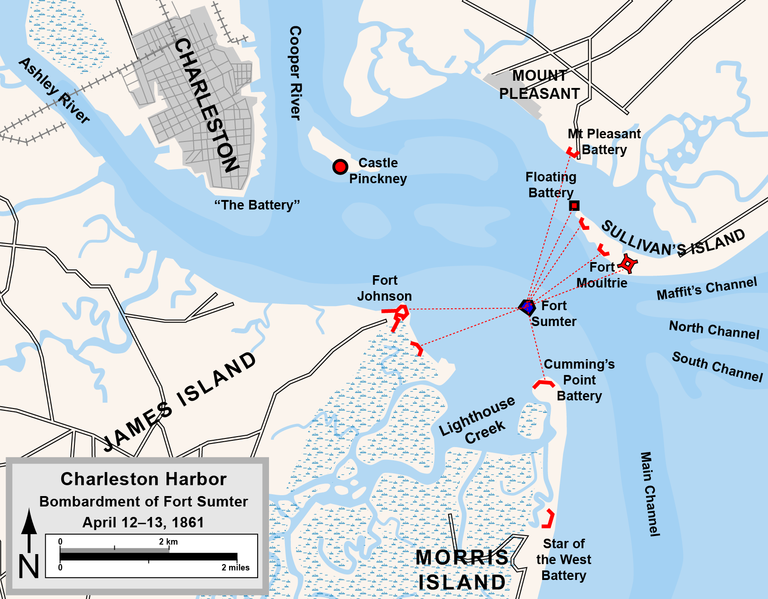
For the site of such a monumental moment in history, it is a rather unknown place in American history today. Fort Sumter was a fort, an unfinished fort to be exact, situated in Charleston Harbor, SC, designed to protect the valuable harbor from foreign foes attempting to invade by sea. At this time though, it had yet to be completely finished and until the commander of Charleston Harbor, Major Robert Anderson, moved his forces there, it was only occupied by a lone soldier, who served as a lighthouse keeper. It was designed to be one of the strongest fortresses in the world,


but this was NOT where the Charleston garrison was stationed though. They were instead quartered on the far inferior Fort Moultrie, a feeble fort dating back to 1776, which had no real defense against land-based attacks (sand dunes had been piled up against the walls, making scaling them easy). However, before the actions of 12 April 1861, Major Anderson (perhaps sensing the secession in the wind) made the decision to move the entire garrison over to Ft. Sumter.


It was to here that Brig. General P. G. T. Beauregard, on 11 April 1861, delivered an ultimatum to Major Anderson, the man who had trained him in the art of artillery at West Point, to surrender Ft. Sumter or face bombardment. Major Anderson refused, saying to the officers that General Beauregard had sent to hear his reply, "If we never meet in this world again, God grant that we may meet in the next." Now the decision of war, would lie with Confederate General Beauregard.

And so it was, that in the darkness of 4:30 a.m., on 12 April 1861, Confederate batteries opened up on Fort Sumter. American guns, fired by American hands, were firing on an American fort, manned by American soldiers. To borrow from the British at Yorktown, "The World Turned Upside Down" 150 years ago this morning.

Major Anderson awaited until the light of morning, before returning fire. However, limited manpower (an already small garrison had been further reduced by sickness and weeks of half-rations) and the unfinished state of the fort itself prevented him from using all of his guns, only 21could be safely fired. The Confederates made a point of targeting the wooden portions of the fort, while the Sumter defenders were mostly ineffective against their Charleston adversaries.

Another issue, which may have helped to force Beauregard's hand, was the early morning arrival of a Union fleet there to resupply Fort Sumter. President Lincoln had previously stated publicly that the ships were only there for a resupply of supplies, that no manpower would be exchanged. However, since the Confederacy was demanding that the fort be handed over to them as property of the state of South Carolina, there was little chance that they would peacefully acquiesce to this federal request. But though the fleet had arrived before the opening Confederate bombardment, they had done nothing and would be able to do nothing all day.

As darkness fell, a light rain began falling, which extinguished the fires started by Confederate hot-shells and the fort ceased firing for the night. Though the Confederates reduced their rate of firing, they kept lobbing shells at the fort throughout the night. Sumter's defenders spent a fitful night.

At dawn's break, the fight resumes in earnest.........

Thursday, April 7, 2011

Shiloh Principle Players

Let's meet the principles involved in the Battle of Shiloh / Pittsburg Landing:

For the Union:

In command and responsible for the battle:

Major General Ulysses S. Grant


And Grant's most loyal Lieutenant and friend:

Brig. General William T. Sherman  

While his late-arriving forces helped tips the odds in the Federals' favor on 07 April 1862:

Maj. General Don Carlos Buell
For the Confederates: 

Their leader as the battle began on 06 April 1862 and who was shot during during the day:

General Albert Sidney Johnston

After his untimely death, the Confederate forces would be left in the hands of this man:

General P. G. T. Beauregard
There were others who played a role, but it is beyond the time and capacity of this historian to describe all of the events that occurred on the fateful days of April 6th and 7th in 1862. 

Battle of Shiloh / Pittsburg Landing

Speaking of General Buell, 7 April 1862 is the second day of fighting in the Battle of Shiloh (also known in the South as the Battle of Pittsburg Landing).

Shiloh was a major battle in the Civil War and one of the bloodiest.  Though both sides tended to ignore what was going on in the Western Theater, this one battle did draw some attention, for two main reasons.  First, was because the day of fighting on 6 April had gone so well for the Confederates (they had manage to push Grant's troops all the way to the river, where they spent the night protected only by artillery) that it seemed impossible that they should not carry the next day of fighting as well.  Second, was the sheer bloodiness of the fighting, the end tally of casualties proved to be the costliest in American history up to that time, with well over 23,000.

As darkness fell on 6 April 1862, the heart wrenching cries of the wounded and dying men could be heard in both Confederate and Union camps.  While the shelling from Union gunboats made the night miserable for the Confederates, the Federals spent the night no better, camped along the shore at Pittsburg Landing and a thunderstorm made both sides miserable.  Unable to withstand the agonizing voices of the wounded, Grant took shelter under a tree and with Sherman began planning for the next day's battle.  "Well Grant, we've had the devil's own day, haven't we?" Sherman remarked.  "Yes," replied Grant.  Lick 'em tomorrow though."

The Confederates (now led by General Beauregard after General Albert Sidney Johnston had been killed) were overly confident that tomorrow would bring a "complete victory" to quote from Beauregard's telegram to President Davis.  Though Sherman and other officers had been surprised and some even routed on 06 April and Grant was indeed trapped at Pittsburg Landing, victory was not as much a garantee as Beauregard proclaimed it to be.  For there had been stiff resistance to the Confederate advance in several places, the Hornet's Nest being the most famous and costly to the Rebels in time, and Grant had a large number of troops at Pittsburg Landing as well as an impressive defense in the form of artillary.  Also, Beauregard had perhaps made a major tactical error in haulting the assault at dusk and not pressing on.

Come the morning of 07 April 1862, there was a nasty surprise awaiting an uninformed General Beauregard, in the form of General Don Carlos Buell and reinforcements which had arrived late yesterday evening.  Once again outnumbering the Confederates, Grant ordered a counterattack.  And at dawn the Federal forces engaged in a massive one.  Grant and Buell launched their assaults separately, but with a great deal of coordination going on down at lower levels.  The Confederate units however were all entangled with each other and there was little unit cohesion.  The Union forces made steady progress in reclaiming their lost camps (where the Confederates had waited out the rains of the last night in more comfort than they had).

By early afternoon Beauregard found his forces mostly back where they had started from prior to 06 April 1862.  He eventually launched a series of counterattacks, but by late afternoon the last of these assaults failed to gain any ground when the Confederates were flanked and severely repulsed.  Low on ammunition and with over 10,000 men dead, missing or wounded, Beauregard, realizing that he had lost the initiative, knew that he could advance no further and so withdrew to a position beyond Shiloh Church.  In the evening of 07 April 1862, the Confederates began an orderly retreat back to Corinth.

In the aftermath of this bloody conflict both commanding generals' reputations would suffer.  Beauregard would lose the respect of President Davis (never to be regained) and would be forever vilified for "losing the Battle of Shiloh" by not fighting on into the evening on 06 April.  Grant's reputation would suffer thanks to reporters (far from the battle) who spread rumors that Grant was drunk and told stories of his men being bayoneted in their tents due to a lack of preparedness.  Grant's superior, General Henry Halleck, even reorganized the armies, relegating Grant to an impotent position as his second in command.  But President Lincoln refused to fire him, saying, "I can't spare this man; he fights."  Sherman's reputation, on the other hand, was made by Shiloh, his steadfastness under enemy fire and amid the chaos of the battle, made-up for his defensive lapses preceding Shiloh.

Eventually though, Grant was vindicated for his performance at the Battle of Shiloh.  His clear judgment retained under a very strenuous and chaotic situation and his ability to clearly see the larger tactical picture, devise a resourceful strategy and then implement it, were the keys to giving Federal forces the ultimate victory.

Unfortunately, the Battle of Shiloh was also instrumental in bringing home to both Federal and Confederates alike that this war was going to be a very bloody affair and one with no clear end in sight.  In fact, there would be three more longs years full of battles just like Shiloh.

Month of the Civil War

I know that I am late in posting this notification, what with 7 days of April already being spent, but better late than never I suppose.  That would be a phrase that I could also apply to several generals, from both sides, throughout the war.  J.E.B. Stuart at Gettysburg and Buell at Shiloh.  So at least I am in good company. 

Anyway, April 2011 is the 150th Anniversary of the beginning of the Civil War.  In fact, the year 2011 is a whole MONTH of 150th anniversaries, from Fort Sumter to First Manassas and on.  Really though, April 2011 is just the tip of the Civil War Anniversary Iceberg.  We really have 4 whole years of 150th anniversaries to look forward to and I shall endeavor to keep your, my few loyal readers, abreast of the important dates. 

Enjoy!